
When timeless beauty meets natural strength, few materials capture the imagination like teak veneer.
Known for its rich golden-brown hues, distinctive grain, and remarkable durability, teak veneer offers a perfect balance of elegance and practicality.
From sleek furniture and custom cabinetry to striking wall panel, this versatile wood transforms interiors with warmth and sophistication, making it a favorite among designers, architects, and homeowners who value both style and performance.
1. What is teak veneer?
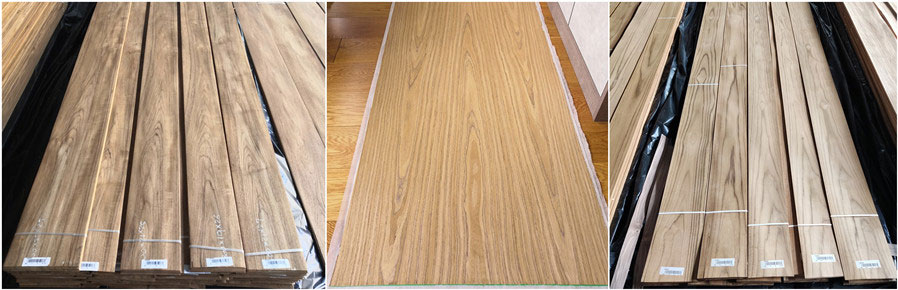
Teak wood veneer, often hailed as the “King of Timbers,” is a premium natural wood veneer valued for its elegance, durability, and versatility.
Known for its high natural density, ranging approximately from 600 to 720 kg/m³ depending on the source, teak veneers offer an ideal balance of strength, stability, and workability.
Its natural oils make it resistant to moisture, insects, and wear, while its color tends to deepen gracefully over time, adding character and warmth to interiors.
Teak is sourced from multiple regions around the world, each with unique qualities:
Plantation Teak veneer that originates from Brazil and Costa Rica in South America features rich, deep golden tones with bold grain.
Thai and Burmese Teak are prized for their uniform, fine textures and classic golden hues.
African Teak provides a sustainable and visually striking alternative with medium-brown shades and interlocked grain patterns.
2. Types of teak wood veneer
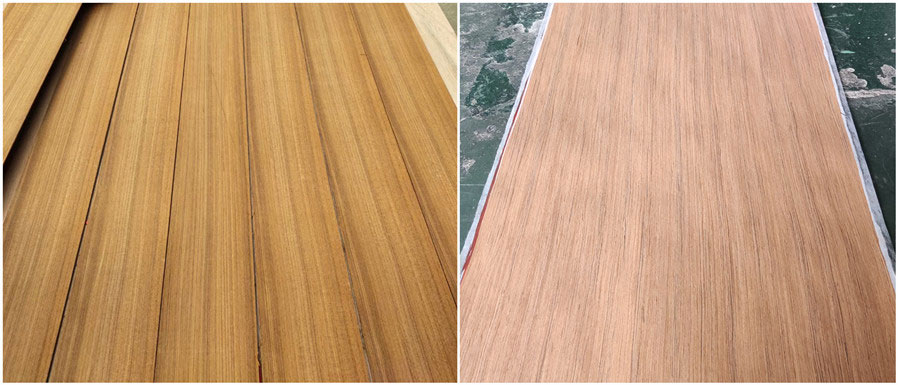
2.1 Natural teak wood veneer
Regarding the natural teak wood veneer origin, there are approximately five different types of natural teak veneer.
2.1.1 Burma teak veneer
Burmese teak wood veneer, often referred to in the market as Thai teak veneer, is one of the most demanded teak veneer types.
It is characterized by a warm golden-yellow tone and relatively straight grain.
Veneers with fewer dark mineral lines are commonly classified as “Yellow teak” and are especially favored for high-end furniture and interior applications.
This type of teak is well known for its natural oil content, stability, and premium appearance.
2.1.2 Plantation teak veneer
Plantation teak veneer is sourced from Brazil and Costa Rica in South America.
It is often referred to as “small teak” due to its faster growth cycle and lighter density compared to natural Burma teak.
While it maintains a teak-like appearance, the grain is generally more uniform, and the oil content is lower, making it a cost-effective alternative for furniture, cabinetry, and interior paneling.
Plantation teak veneer is naturally divided into Brazilian teak and South American teak, offering subtle variations in color and texture.
2.1.3 Golden teak veneer
Golden teak originates mainly from Papua New Guinea, also known as Wau beech (Elmerrillia tsiampacca).
It features a bright golden color with relatively straight and clean grain patterns.
This veneer is commonly used in decorative interior applications where a warm and uniform appearance is desired.
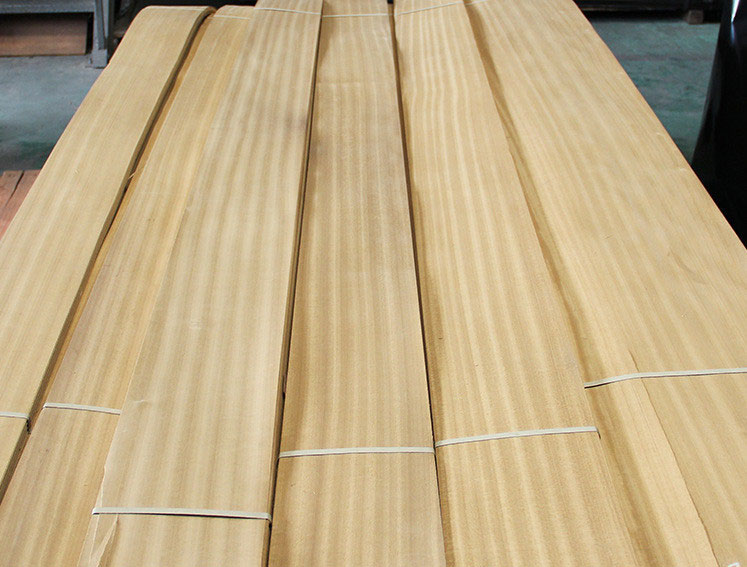
2.1.4 Africa teak veneer
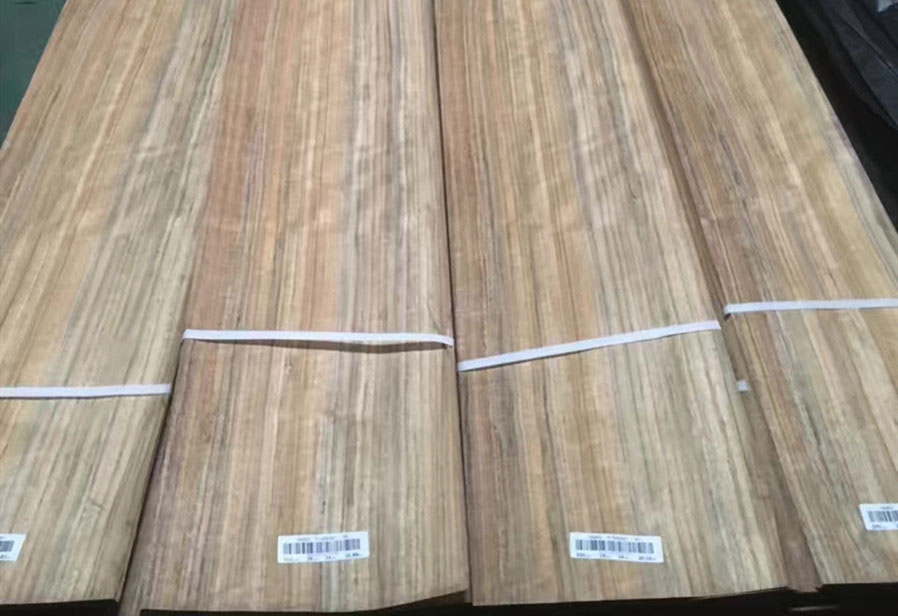
2.1.5 Afrormosia veneer
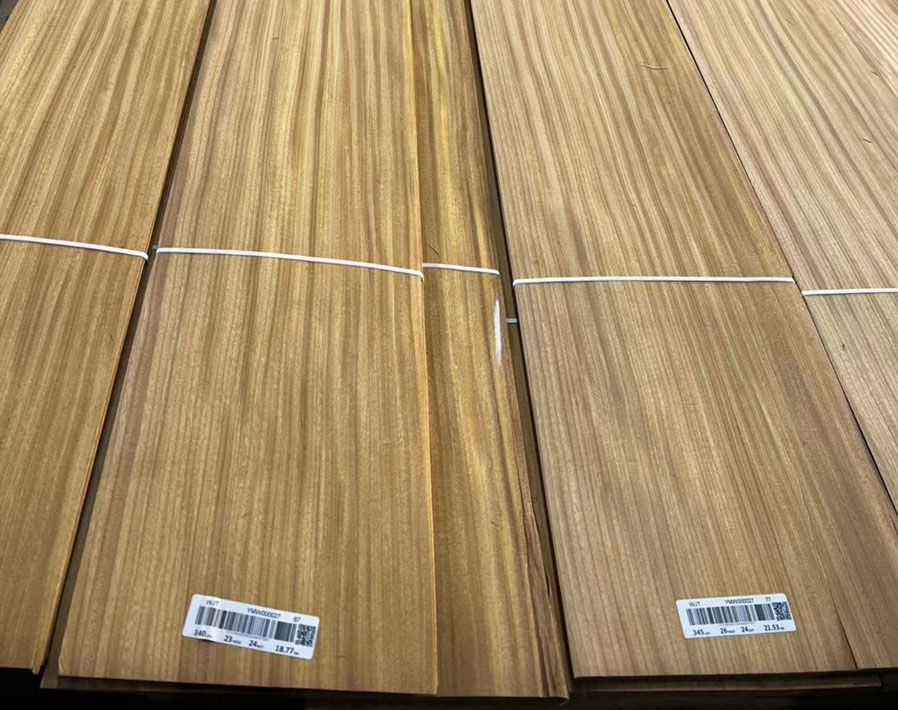
Afrormosia veneer is often referred to as the name of “King of African Teak” in China due to its excellent stability, fine grain, and teak-like performance.
Despite its superior appearance and properties compared to African teak, its market price is generally lower, making it a highly competitive option for furniture and architectural applications requiring both quality and cost control.
Afrormosia veneer is available in a range of thicknesses to accommodate different applications and performance requirements.
Regarding the thickness of the above 5 types of teak wood veneer, there are approximately 3 different types of natural teak wood veneer.
2.1.6 0.2-0.25mm thin teak veneers
Thin teak veneers are inherently prone to cracking or deformation.
To enhance stability and workability, backing materials such as fleece or kraft paper are commonly applied.
Fleece-backed teak veneers provide flexibility for curved surfaces, while paper-backed veneers ensure uniform adhesion and smooth finishing.
These backed teak veneers are ideal for fine furniture, cabinetry, profile wrapping, and decorative panels with complex geometries.
2.1.7 0.4mm and 0.5mm standard thickness of teak wood veneer
Slightly thicker teak veneers offer greater durability while preserving the natural beauty of teak.
They are suitable for furniture, wall panels, cabinetry, and other interior applications.
These veneers are easy to work with, stain, and finish, delivering the appearance of solid teak at a lower material cost.
2.1.8 1 mm, 2 mm, 3 mm, and 5 mm thick teak veneer
Thick teak veneers provide a solid feel and high-end finish, suitable for luxury furniture, feature walls, and specialty woodworking projects.
Regarding the teak wood veneer grain, there are approximately 3 different types of natural teak veneer.
2.1.9 Flat cut (Crown cut) teak veneer
Flat cut, also known as crown cut, teak veneer is produced by slicing the log tangentially to the growth rings.
This cutting method highlights teak’s natural, decorative appearance, featuring broad cathedral- or crown-shaped grain patterns.
The veneer typically displays warm golden-brown tones with flowing, expressive grain, making it especially suitable for furniture, cabinetry, doors, and wall panels where visual impact is important.
Due to its balanced combination of aesthetic appeal and workability, Flat cut (Crown cut) teak veneer is widely used in both residential and commercial interior applications.
2.1.10 Quarter cut (Straight cut) teak veneer
Quarter cut straight grain teak Veneer is produced by slicing the log perpendicular to the growth rings.
This cutting technique creates a uniform, linear grain pattern with a clean and refined appearance.
Characterized by consistent golden to medium-brown tones and straight, parallel grain lines, quarter-cut teak veneer offers excellent dimensional stability and reduced risk of warping or movement.
Its orderly grain structure makes it particularly suitable for modern furniture, cabinetry, wall panels, and architectural interiors where visual consistency is essential.
2.1.11 Woven teak veneer
Woven teak veneer is a decorative veneer created by interlacing thin strips of teak in a woven pattern, resulting in a distinctive textured and three-dimensional appearance.
This technique combines the natural warmth and rich golden-brown tones of teak with a geometric, handcrafted aesthetic.
The woven structure enhances visual depth and surface interest, making it an ideal choice for feature panels, cabinet doors, furniture fronts, and accent walls.
Regarding the jointed or spliced wood veneers, there are approximately 2 different types of natural teak veneer.
2.1.12 Finger joint teak veneer rolls for edgebanding and profile wrapping
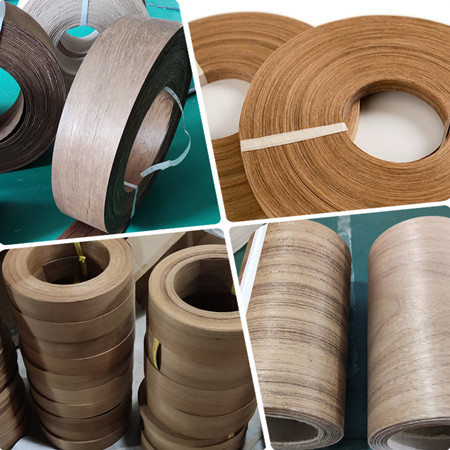
Teak veneer rolls are produced by slicing or peeling teak veneers and then supplied in roll form for efficient processing and application.
Finger-jointed teak veneer rolls offer enhanced strength, stability, and material efficiency, with well-matched joints that create a clean and consistent appearance.
They are an eco-friendly solution that maximizes wood utilization while maintaining the natural beauty of teak.
For edge banding, teak veneer rolls are typically supplied in widths ranging from 15–60 mm, suitable for finishing straight edges on veneered board and furniture components.
For profile wrapping, wider rolls of 60–300 mm are used, allowing seamless coverage of both flat and curved surfaces.
This makes teak veneer rolls an ideal choice for modern furniture and interior applications requiring both aesthetic continuity and functional performance.
2.1.13 Matched teak veneer layons
Matched teak wood veneer layons are composed of individual teak veneer leaves that are carefully arranged and joined to form larger, ready-to-use sheets.
Through precise matching techniques, the natural color and grain of teak are aligned to create a balanced, harmonious surface appearance.
Common matching styles include book match, slip match, and random match, each offering a distinct visual effect—from symmetrical and elegant patterns to more natural, flowing grain continuity.
The warm golden-brown tones and characteristic grain of teak are enhanced through matching, making layons ideal for high-end furniture, cabinetry, doors, wall panels, and architectural interiors.
2.2 Reconstituted teak veneer
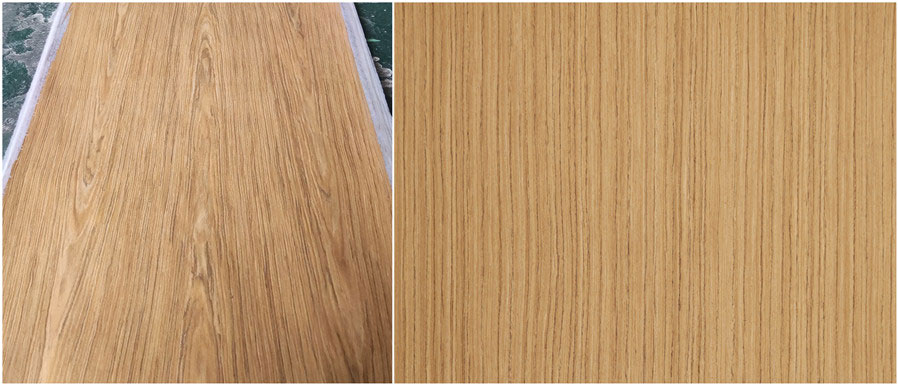
Reconstituted teak veneer offers the perfect combination of natural beauty and sustainability, providing an eco-friendly alternative to traditional solid teak veneers.
Made from dyed fast-growing wood, it replicates the rich golden-brown tones and distinctive grain patterns of natural teak wood, with a uniform, consistent appearance achieved through its innovative production process.
The recon teak veneer is crafted by reprocessing dyed thin slices of Ayous veneer into a highly durable and stable material, reducing waste while preserving the elegance of teak wood grain and color.
With a density ranging from 0.7 to 0.75 g/cm³, it maintains the same strength, durability, and aesthetic appeal as natural teak, making it suitable for furniture, cabinetry, wall panels, doors, and moulding profiles.
3. How to choose teak veneer from different origins?
Teak veneer is popular in furniture, cabinetry, wall panels, and interior design because of its durability, attractive grain, and stability.
Its properties, however, vary depending on origin and species.
Burma teak, or Thai teak, from Myanmar and Thailand, has warm golden-yellow tones and mostly straight grain.
Premium sheets have minimal dark streaks and high natural oil content, making them durable, moisture-resistant, and stable.
This makes Burma teak perfect for luxury furniture, high-end cabinets, doors, and feature panels, though it’s more expensive and less readily available.
Plantation teak from Brazil and Costa Rica is lighter in color, with nice grain and cost-effective, and sustainably sourced.
It works well for furniture, cabinets, and wall panels where budget and eco-friendliness matter.
Golden teak, mainly from Papua New Guinea, has bright golden tones and clean, straight grain.
Its uniform look makes it ideal for modern furniture, decorative panels, and feature walls, though it may lack some of the natural variation of premium teak.
African teak from West and Central Africa has medium-brown interlocked grain.
It looks similar to Burma teak but has less oil, so it’s less durable.
Still, it’s an affordable option for furniture, cabinetry, and panels, especially in budget-sensitive projects.
Afrormosia veneer also comes from Africa and has a deep golden-brown color, fine straight grain, and good stability.
It’s close to Burma teak in performance and appearance but comes at a lower price, making it great for furniture, cabinets, wall panels, and architectural elements.
In short, choose Burma teak for high-end luxury projects, Plantation or African teak for cost-conscious or sustainable projects, Golden teak for uniform modern designs, and Afrormosia when you want a balance of quality, durability, and price.
Knowing these differences helps designers and builders pick the right teak veneer for your projects.
4. Elegant uses of teak wood veneer: Where luxury meets functionality
4.1 High-end teak veneer door
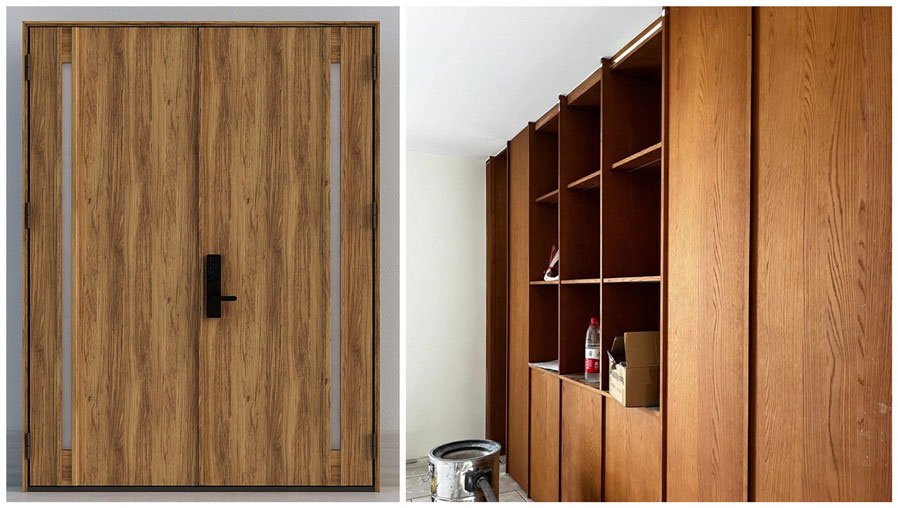
Teak veneer is commonly applied to door panels, door frames, and door edge banding, allowing for a consistent and unified finish across the entire door system.
For door applications, teak veneer thickness is typically 0.2–0.5 mm for natural teak veneer and reconstituted teak veneer, offering a good balance between workability and durability.
Standard veneer widths generally range from 15–300 mm for edgebanding and door frame wrapping, with longer lengths preferred to reduce visible joints on door panels.
For projects requiring high consistency across multiple doors—such as hotels, offices, or residential developments—high-quality reconstituted teak veneer is also an excellent option, ensuring uniform grain and color matching while controlling costs.
4.2 Teak veneer cabinetry
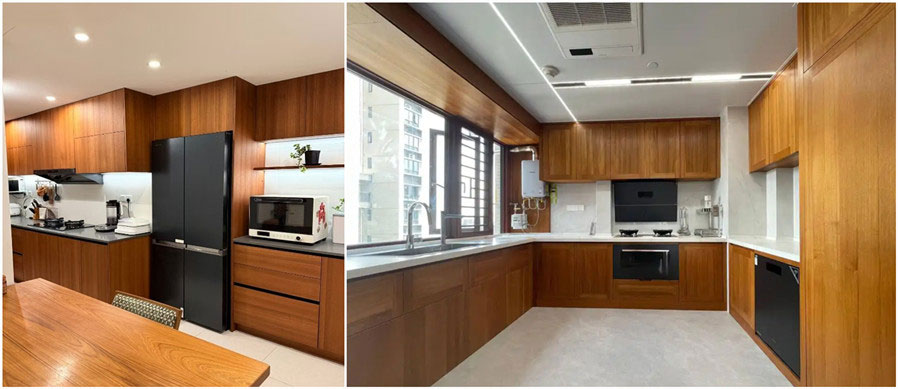
Applied to kitchen cabinets, wardrobes, and built-in storage units, teak veneer provides a smooth, luxurious surface.
Its natural oils and hardness help resist moisture and wear, while the veneer’s flexibility allows edge banding and wrapping for seamless cabinet profiles, making it perfect for sophisticated teak veneer designs and a high-quality teak veneer finish.
4.3 Teak veneer tables and furniture
Teak veneer enhances table tops, side panels, drawer fronts, and shelving, delivering the appearance of solid teak at a lower cost.
Its uniform color and grain make it suitable for both modern and classic furniture designs, making it an ideal choice for teak veneer furniture and projects requiring a high-quality teak wood finish veneer, while maintaining structural stability.
4.4 Teak veneer wall panels
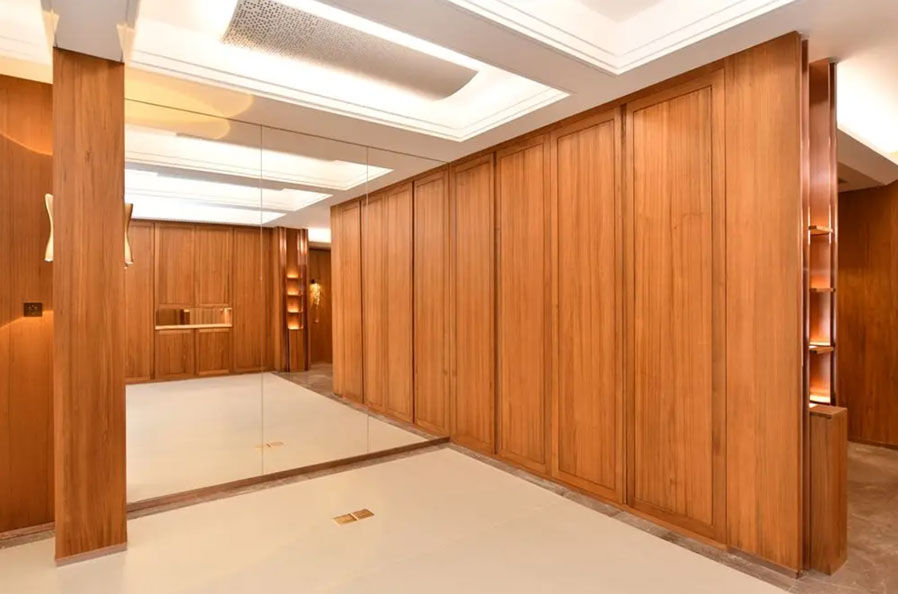
Teak veneer brings the rich warmth and timeless elegance of teak wood to interior walls, transforming ordinary MDF, plywood, or marine plywood panels into premium surfaces.
When applied to MDF or standard plywood, it offers a smooth, consistent finish ideal for cabinetry, feature walls, and furniture-backed panels.
On marine plywood, teak veneer not only enhances visual appeal but also provides durability and moisture resistance, making it perfect for high-humidity environments such as kitchens, bathrooms, or even yacht and boat interiors.
This plywood is made from high-quality marine-grade plywood, combining durability, moisture resistance, and a smooth, consistent surface.
It is ideal for cabinetry, furniture panels, feature walls, and luxury joinery where both aesthetics and performance are important.
4.5 Teak veneered architectural moulding profiles
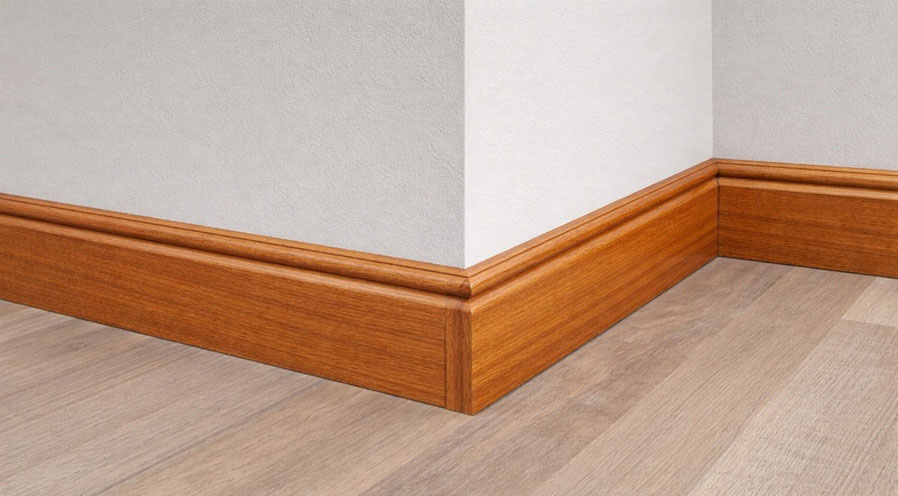
Teak veneer is widely used on architectural trims and decorative elements, including moulding profiles, door frames, skirting boards, and picture frames.
Thanks to its natural flexibility and stable grain structure, teak veneer can be smoothly wrapped over profiles, edges, and curved or detailed shapes, delivering a seamless and refined finish.
It brings warmth, consistency, and a high-end look to interior details, ensuring a harmonious appearance across all architectural surfaces.
5. Teak veneer import and export in China
5.1 Heavily reliant on imports, with supply increasingly diversified
China relies on imports for teak veneer raw materials, as domestic resources are scarce.
Teak is a tropical precious species, suitable only for planting in Yunnan, Hainan, and Guangxi.
In 2023, the total area of man-made teak forests nationwide was 126,000 hectares, with less than 18% of mature forests available for harvesting. The annual yield was about 280,000 cubic meters, far below domestic demand.
In 2023, China imported 893,000 cubic meters of teak logs and lumber, accounting for 74.2% of total consumption, of which over 60% was used for processing teak veneers.
Imports are primarily from Southeast Asia, with Africa as a supplement.
In 2023, Myanmar, Laos, and Thailand together accounted for 76.7% of total imports, with Myanmar alone contributing 38.6%.
In recent years, Southeast Asian countries have tightened export policies: Myanmar banned log exports and restricted lumber, Laos only allows deep-processed products for export, and Thailand’s export volumes are unstable.
Consequently, China has expanded sourcing from Africa, with its import share rising from 11.2% in 2023 to 35% in 2025, reducing supply risks.
5.2 High-end processed exports limited by international compliance
China mainly exports high-end processed teak veneers, leveraging mature slicing, staining, and finishing techniques.
These products are exported to Europe, the US, the Middle East, and Southeast Asia, often used in yacht interiors and high-end furniture.
In 2023, exports of products meeting the EU’s new standard (EN 350:2024) increased by 48%, while non-compliant products decreased by 22%. Technological upgrades are key to maintaining export share.
International compliance requirements are becoming stricter. The EU Timber Regulation (EUDR), effective June 2023, requires timber products to provide traceability and deforestation-free certification, raising costs and limiting small and medium traders.
China plans to issue a national standard for timber legality by 2025, with mandatory enforcement in 2026.
Meanwhile, the RCEP tariff benefits are emerging: Thailand’s tariff on Chinese teak veneer sheets has dropped to 5.6%, and is expected to reach zero by 2026, promoting cooperation between Chinese companies and ASEAN primary processing bases.
Leave A Comment